

There was a time when SEO was simple.
Pick a keyword, repeat it enough times, and you have a shot at ranking.
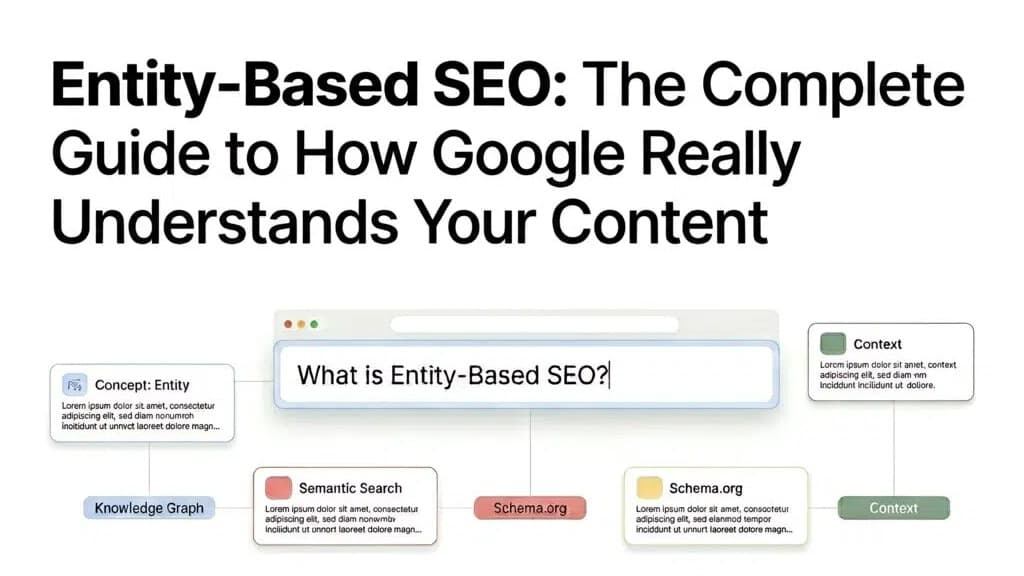
That era is over. Today, Google doesn’t just read your words; it understands your meaning. And that shift has one name: entity-based SEO. Entity-Based SEO focuses on optimising content around clearly defined topics and their relationships, helping search engines understand meaning instead of just matching keywords.
Most websites are still playing a keyword game that Google has already moved past. If you’re wondering why well-written content isn’t ranking, or why some pages seem to “just work” without obsessive keyword placement, this guide will answer that. Let’s break it down from the ground up.
What Is Entity-Based SEO?
Entity-Based SEO is an approach to optimisation that focuses on clearly defining people, brands, products, and concepts (entities) and their relationships, rather than relying only on keywords. It helps search engines understand the full meaning and relationships behind your content, making it easier for Google to match your pages with relevant user queries across different contexts.
What this really means is: Instead of optimising for phrases, you optimise for clarity of meaning.
That distinction built through context, structure, and relationships is what entity SEO is all about.
Practical example:
A page optimised only for the keyword “apple” lacks clear meaning for search engines
The term “apple” can refer to multiple things (fruit, brand, etc.), creating ambiguity
Adding context helps define the intended entity
When a page includes references like:
Tim Cook
App Store
iPhone releases
WWDC
These signals clearly indicate that the content is about the Apple brand
Consistent contextual references strengthen entity recognition
A clear entity definition helps search engines understand intent better
As a result, the page is more likely to rank for relevant queries
What Is an Entity in SEO?
An “entity” in SEO is anything that has a distinct, independent existence in the real world and can be clearly identified. Google’s own documentation describes entities as “a thing or concept that is singular, unique, well-defined, and distinguishable.”
This includes:
A person (a public figure, author, expert)
A brand (a company or business name)
A place (a city, region, or landmark)
A product (a tool, device, or service)
An idea (a topic like content marketing or UI design)
An entity is defined by what it’s connected to.
For example: “Nike” connects to:
Sportswear
Shoes
Athletes
Fitness
Each entity has attributes (properties) and relationships (connections to other entities).
Also Read: Everything You Need to Know About YMYL in SEO and Its Impact on Rankings

Entity SEO vs Keyword SEO
This comparison table makes the core difference between entity SEO and keyword SEO clear at a glance:
Factor | Keyword SEO | Entity-Based SEO |
Definition | Targets specific word strings | Targets real-world things and concepts |
Role | Triggers exact match signals | Builds topical authority and context |
How Google uses it | Match query terms to page text | Understand meaning, context, and relationships |
Risk | Keyword stuffing, thin content | Requires deeper, well-structured content |
Importance in 2026 | Declining as a standalone strategy | Central to modern semantic SEO |
To be clear: Think of keywords as the vocabulary and entities as the grammar. You need both, but one gives structure to the other.
Or simply say,
Keywords = what people type
Entities = what they actually mean
How Google Uses Entities: The Knowledge Graph
Search engines build a structured understanding of the world using interconnected data.
This system is often called a knowledge graph. Google’s Knowledge Graph is essentially a massive, interconnected database of entities and their relationships. When you search for something, Google doesn’t just scan text; it maps your query to known entities and returns results based on meaning.
Instead of treating your page as isolated text, search engines ask:
What entity is this about?
What is it related to?
How trustworthy is this source?
This also connects directly to how crawling and indexing work in SEO.
Here’s the classic example that explains everything:
If you search “Python course”
Google evaluates:
Programming language?
Snake-related content?
Then it checks the surrounding context:
Coding terms → programming
Biology terms → snake
Google does this using a combination of structured data, co-occurring terms, links from authoritative sources, and the overall topical landscape of a site. The clearer and more consistent your content is about a specific entity, the better Google can place you in the right context.

How to Check If Google Understands Your Content
Understanding entity SEO is one thing. But knowing whether Google actually understands your content is what really matters.
Here are 5 simple tools you can use to check that:
1. Google Search Console
This is the most important tool.
Check:
What queries your page ranks for
Keyword variations
Impressions and clicks
If your page ranks for related terms, Google understands your topic well. If it ranks only for one keyword, your content may lack depth.
2. Google Natural Language API
This tool shows how Google reads your content.
It highlights:
Entities detected on your page
Topic categories
Relevance scores
If the main entity is missing or weak, your content needs better context.
3. Google Rich Results Test
Use this to check your structured data (schema).
It tells you:
Whether your content is eligible for rich results
If Google can clearly identify your page type
A proper schema helps Google understand your content faster.
4. InLinks Entity Checker
This tool focuses on entity-based SEO.
It shows:
Entities present in your content
Missing related topics
Content gaps
It helps you improve topical coverage and strengthen your main entity.
5. Google Search (Manual Check)
This sounds simple, but it’s powerful.
Search your topic and check:
“People also ask”
Related searches
Top-ranking pages
These show what Google connects to your topic. If your content doesn’t cover these, you’re missing important context.
Why Entity-Based SEO Matters in 2026
Search has changed. It’s not just about matching words anymore. It’s about understanding what people actually mean.
Here’s why entity-based SEO matters now and how it helps your content perform better.
1. AI Search Picks Clear, Helpful Content
Tools like Google AI Overviews, Perplexity AI, and ChatGPT don’t just look for keywords.
They look for:
Clear explanations
Well-defined topics
Content that connects ideas properly
What to do:
Explain your topic clearly from the start
Add related points (not just one idea repeated)
Use simple, direct language
If your content is easy to understand, AI tools are more likely to use it as a source. We’ve explained this shift in detail in our AI search optimisation guide.
2. Voice Search Works Like Real Questions
People don’t type like robots anymore. They speak normally. Voice search is a big part of this shift, which we’ve already covered in our blog on voice search optimisation.
Example:
Typed: “Tesla founder”
Voice: “Who started Tesla?”
Search engines now look for direct answers, not keyword matches.
What to do:
Add question-based headings
Give clear answers in 2–3 lines
Avoid long, confusing sentences
If your page answers questions clearly, it has a better chance to show up in voice search.
3. Google Understands Meaning, Not Just Words
Google systems like Google BERT and Google MUM try to understand the full topic.
That means:
You don’t need to repeat the same keyword
You need to explain the topic properly
What to do:
Cover the topic in depth
Add related ideas and examples
Use natural variations of words
A well-explained page can rank for many searches, even if the exact keyword isn’t used.
4. Google Shows Results Based on User Interest
Search results are not the same for everyone.
Google looks at:
What people search often
What topics they follow
If someone is interested in fitness, they’ll see more fitness-related results.
What to do:
Stay focused on one main topic
Build multiple pages around it
Keep your content consistent
When your site is clearly about one topic, Google shows it more often to the right people.
Quick Optimisation Checklist
Use this while writing:
Clearly define what your page is about
Add related topics and explanations
Answer common questions directly
Use simple, natural language
Connect your pages with internal links
Keep your topic focus consistent

How Entity-Based SEO Works: Step-by-Step
Understanding how entity-based SEO works in practice is the bridge between theory and results. Here’s the process:
1. Identify your core entities
What is your website fundamentally about? Define the primary entity (your brand, topic, or niche) and map its key attributes and related entities. A fitness blog’s core entity might be “strength training,” with related entities like “progressive overload,” “compound movements,” and “muscle hypertrophy.”
2. Build pillar pages
Create comprehensive, authoritative pages that fully cover your core entity. These aren’t just long, they’re complete. A pillar page on “entity-based SEO” should cover definitions, history, strategy, and examples in a single, structured resource.
3. Create topic clusters
Supporting content that explores related entities and subtopics strengthens the main pillar. Each cluster article adds depth and signals to Google that your site has genuine authority in this space.
4. Use strategic internal linking
Link cluster pages back to your pillar, and from your pillar outward. This signals topical relationships, essentially hand-drawing the connections that Google’s knowledge graph expects to find.
5. Maintain consistency across all channels
Your brand name, descriptions, and terminology should be identical across your website, Google Business Profile, social bios, and structured data. Inconsistency confuses Google’s entity resolution; it can’t confidently confirm you are who you say you are.
Entity SEO Strategy You Can Actually Use
Here’s where things get practical. A solid entity SEO strategy includes:
Use schema markup
Implement structured data (Organisation, Person, Article, FAQPage) so Google can directly read your entity metadata. This is the clearest signal you can send.
Get listed on authority sources
Wikipedia, Wikidata, Crunchbase, and industry directories all help Google corroborate your entity. A Wikidata entry significantly boosts entity confidence.
Build topical authority through content depth
Don’t publish 20 shallow posts. Publish 5 deeply researched ones that thoroughly cover an entity and its relationships.
Earn entity-relevant backlinks
Links from sites that cover the same topical entities you target carry far more weight than generic links. A food blog citing your food brand page is stronger than a random directory link.
Audit your entity footprint
Search your brand name in Google. Look at the Knowledge Panel (if you have one), related searches, and “People also ask” boxes. These reveal how Google currently understands your entity.
Write Like You’re Explaining, Not Impressing
Clear writing wins over complex writing.
Entity SEO for AI & LLMs: GEO Optimisation
This is the frontier, Generative Engine Optimisation (GEO) and understanding it now puts you ahead of most marketers.
When AI systems like Claude, ChatGPT, or Google’s AI Overviews generate answers, they draw from sources they can clearly parse and trust. Here’s what that means for your content:
Clarity wins: AI doesn’t tolerate ambiguity. If your content says one thing in one place and something different elsewhere, it won’t be trusted as a source.
Explicit relationships matter: Don’t just mention entity names, explain how they connect. “X is the CEO of Y” is more useful to an AI system than just mentioning both names on the same page.
Structured formats get featured better: Headers, definitions, and clearly labelled sections (like this FAQ below) are far more likely to be extracted by AI search systems than dense, unstructured prose.
Answer questions directly: AI systems are in the business of answering questions. Content that leads with direct, clear answers, not preamble, gets surfaced more often.
Common Mistakes That Kill Entity SEO
Thin content: Publishing 300-word posts doesn’t establish entity authority. Depth signals expertise.
Keyword stuffing: Forcing keywords disrupts natural entity signals. Write for meaning, not density.
Weak internal linking: Without links connecting your topic cluster, Google can’t trace the relationships you’re claiming.
Inconsistent branding: Using different names or descriptions across platforms fragments your entity profile and confuses Google.

Conclusion
SEO isn’t just about keywords anymore; it’s about making your content easy to understand.
Entity-Based SEO helps you do that. Instead of focusing only on what people type, you focus on what they actually mean. You explain your topic clearly, connect related ideas, and keep your content structured.
When you do this:
Google understands your content better
Your pages can rank for more searches
Your content stays relevant for a longer time
The main idea is simple:
Don’t just use keywords.
Make your topic clear.
If your content clearly shows what it’s about and how everything connects, search engines—and even AI tools- can trust it and show it to the right people.
And that’s what really helps you grow in search.
